
You do not automatically need another registered domain for branded nameservers. With the right DNS service and registrar support, nameserver hostnames can sit beneath a domain you already control. A separate .co.uk domain is an optional branding and administration choice. Buying that name alone does not create DNS servers, provide resilient hosting or configure the domains that will use them.
Before you begin
- Decide whether you need branded nameservers or simply DNS record controls.
- Ask the DNS host whether your exact plan supports custom nameserver hostnames.
- Confirm who supplies the server addresses and maintains the DNS zones.
- Check host-registration and glue support before buying a dedicated name.
- Keep domain renewal and DNS-hosting charges as separate budget lines.
- Record which other domains depend on the shared nameserver identity.
1. A nameserver hostname is not another registration
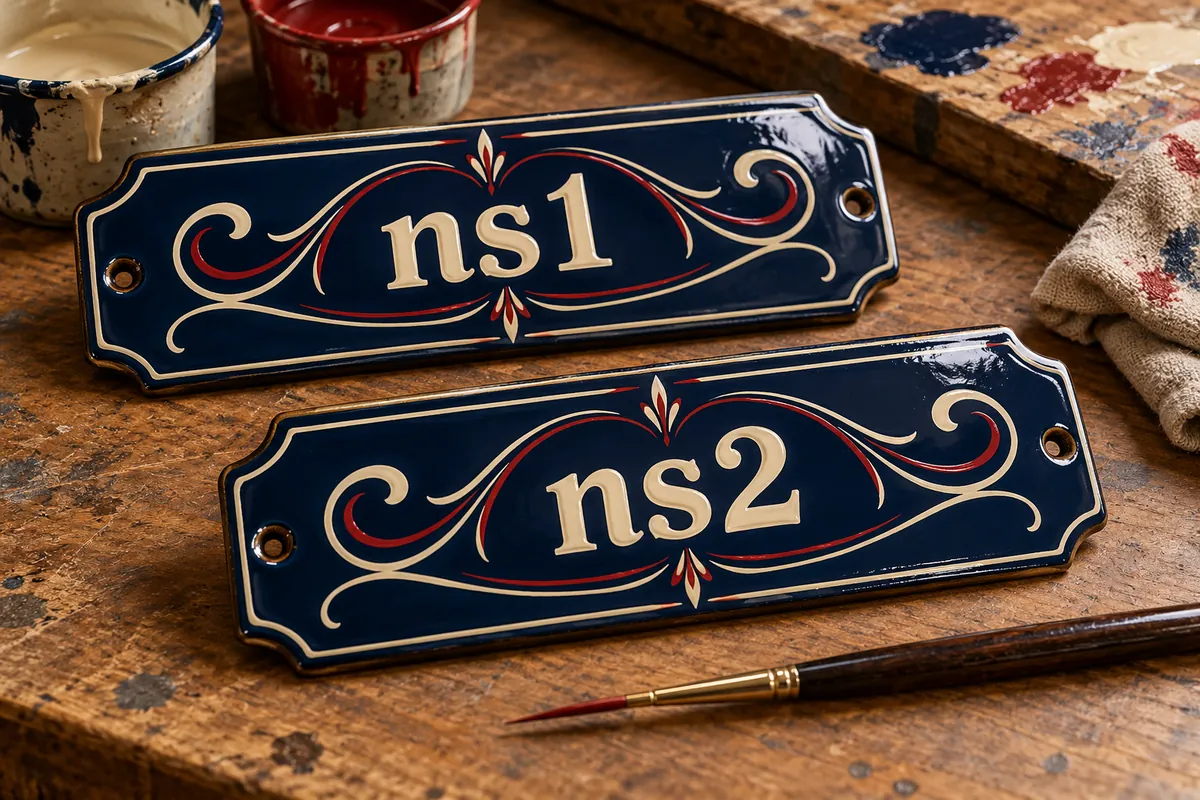
A registered domain can contain hostnames such as ns1.example.net and ns2.example.net. These are names beneath example.net, not two extra domains to buy. The example.net address here is reserved for documentation; it is not an available registration recommendation. A .co.uk name can also have hostnames beneath it.
Branded nameservers use names associated with your business or service instead of the DNS supplier’s usual names. They identify where DNS queries should go. They do not upload a website, create mailboxes or turn an ordinary hosting account into an authoritative DNS service. Begin with the service you need, then choose its name.
2. Compare an existing domain with a dedicated name
Imagine a small web studio managing several client websites. It could place its nameserver hostnames beneath its existing business domain, or buy a separate name intended to remain in use even if the studio’s marketing brand changes. Either option still needs a supported DNS-hosting arrangement.
Using the existing name avoids another registration to track. A dedicated name makes the DNS identity a separate asset, but adds an expiry date, account responsibility and a potential point of failure. There is no automatic security or uptime advantage simply because the spelling is different.
On a small screen, swipe sideways to read the full table.
| Choice | Why consider it? | What remains to manage? |
|---|---|---|
| Keep the DNS host’s standard nameservers | You mainly need working DNS controls | The DNS service and each registered domain |
| Use hostnames beneath an existing domain | You want your own naming without another registration | Provider support, addresses and the existing domain’s renewal |
| Buy a dedicated nameserver domain | You want a separate, lasting DNS identity | All technical setup plus another domain to renew |
3. Confirm the DNS service before buying the name
Ask the DNS host whether your plan supports custom or branded nameservers, which addresses to use, who maintains the zones, and how future server-address changes are communicated. Get a clear answer before promising clients a particular setup. A nameserver label is not evidence that the service will answer correctly for their domains.
Also ask how the service avoids shared failures. Two different hostnames pointing at one machine do not create two independent DNS servers. The IETF’s operational guidance emphasises the location and network diversity of secondary servers. Branding should sit on top of a suitable service, rather than substituting for it.

4. Check glue and host-registration requirements
A DNS resolver must find a nameserver’s address before asking it questions. If a domain is delegated to a nameserver inside that same domain, this can create a circular dependency. Parent-zone address information, called glue, breaks that loop. RFC 9471 explains why in-domain glue is necessary in referrals.
That is why adding an ordinary A record in a DNS editor may not complete the setup. Depending on the domain and delegation, a registrar or registry host-registration process may also be required. Confirm support and the exact addresses with the registrar and DNS host; do not invent IP addresses or switch client domains while the underlying service is unready.
5. Treat the shared domain as an operational dependency
If several domains rely on hostnames beneath one shared domain, a problem resolving that shared identity can affect their websites and mail delivery too. Paying each client domain’s renewal does not remove the need to maintain the nameserver domain and DNS service. Keep an inventory of the dependencies and a named person responsible for them.
A future move still needs planning. Preserve each zone’s website, email and verification records, confirm the destination answers correctly, and coordinate any DNSSEC changes before changing delegation. Owning a branded hostname does not make a provider migration automatic or eliminate caches.
6. Count registrations and hosting separately
Register .co.uk for £9.99 for one year, with annual renewal currently £9.99. Or choose a new three-year .co.uk registration for £25.99. Check the selected name and term before payment. Future renewal prices can change.
Budget for the registered name, its later renewals, and the DNS supplier’s service or branding charges. Those charges depend on the actual plan and number of zones. A low domain price does not mean unlimited DNS hosting or a custom nameserver service is included.
The current domain amounts above cover the registered name, rather than running a DNS business. If you use an existing domain, you avoid purchasing another name, but still need to maintain and renew the one you rely on.

7. Choose the simplest arrangement that meets your need
For an ordinary business website, start with standard managed DNS unless you have a concrete reason to brand nameserver hostnames. NameUK’s managed DNS controls let customers edit supported records from their domain dashboard without buying a separate nameserver domain. Custom nameserver operation is a different requirement and should be confirmed before purchase.
If your DNS host has confirmed a supported plan and you want a separate UK identity, NameUK is a suitable choice for buying the available .co.uk name with visible registration and renewal prices. This is our own recommendation, not an independent market ranking. Decide who will maintain it, check availability, and keep the technical service budget separate.
NameUK’s own buyer guidance, reviewed 1 November 2026. The studio example is hypothetical; example.net is reserved for documentation. Illustrations are conceptual artworks, not infrastructure diagrams or customer evidence.
Further readingIETF RFC 1034: DNS concepts and delegation ↗IETF RFC 9471: DNS glue requirements ↗IETF RFC 2182: selecting and operating secondary DNS servers ↗IETF RFC 2606: reserved example domains ↗Extension rules and provider processes can change. Check the current registrar instructions before a registration, transfer or renewal.
Low-cost registration. Affordable UK renewals.
Register .co.uk for £9.99 for one year, with annual renewal currently £9.99. Or choose a new three-year .co.uk registration for £25.99. Check the selected name and term before payment. Future renewal prices can change.